
Gavin McKenna: A Player Autopsy
Intro
Back in August, the 2026 Draft was being hyped up as the Draft where Gavin McKenna would reign supreme. It had real vibes of another potential sweepstakes; a Draft that featured such a generational prospect that teams would be doing everything they could to scrape the bottom of the league standings, just for a chance at Drafting McKenna: a player that many people truly believed could reboot any franchise. It got to a point where people started to question whether or not McKenna was a better Draft prospect than his cousin, Connor Bedard, was in 2023. Many believed that McKenna’s offensive abilities weren’t just elite, but a godsend. He was something so unattainably above his peers that it was only comparable to watching your uncle play all-time QB with your cousins in the backyard during a family cookout.
During the 2024-25 season, Gavin McKenna was that guy. It seemed like every day, a new video would emerge about something ridiculous that he had pulled off during one of his Western Hockey League games. Constantly, McKenna’s flashy play made headlines. Drenching social media and covering every hockey news outlet, what he was doing was nothing short of spectacular. Combine that with the fact that he came from a tundra town of just 30,000 people (more formally known as Whitehorse, Yukon) and was never supposed to be this good in the first place, and McKenna was everyone’s first topic of discussion.
Fast forward about half a year to the end of February, McKenna is starring for Penn State - the currently 5th-ranked team in the country - and is red hot at possibly the best time. But on top of all this, McKenna is slowly building up a reputation for himself as one of the most polarizing players in this year’s draft. It’s rare to find someone this talented, while at the same time being questioned this much. It’s almost like, to an extent, that even with all that McKenna has accomplished 28 games into the season, it still isn’t enough. The Gavin McKenna situation stems far beyond what he has done on the ice and begs us to be self-reflective. Is it possible that, despite how good McKenna is, he’ll never be able to live up to the gaudy hype we have for him, simply because it’s not actually achievable? If so, it might be time for us to start reevaluating how we judge prospects and the sky-high expectations we so often hold them to.
Today, I’m going to extend deeper than the felony charges and panicky headlines. My goal will be to unveil the true player archetype that makes Gavin McKenna and put into perspective not just how good he really is, but how good he’s becoming.
Part 1: Forks Down
Exploring the shortcomings in McKenna’s game through the Celebrini comparison, and how a rough start exposed his deficiencies.
McKenna’s first semester of college hockey was filled with ups and downs, but mainly what many considered the failure to reach sky-high expectations. Despite opening up his collegiate career with one of the season’s most iconic moments - scoring the game-winning goal against Arizona State whilst the entire hockey world was watching - McKenna’s first 16 games of college hockey were, to put it bluntly, underwhelming. 18 points was not the output that people expected for a player who had posted 129 just the year prior, and for someone who was being touted as the next best thing since Connor Bedard. Not to mention, this was the player that every single college in the country wanted a piece of; a player that schools were throwing football-level chunks of NIL money at.
But was McKenna really falling that short of expectations? I mean, a point-per-game pace as an 18-year-old freshman leading the then 8th-ranked Nittany Lions isn’t too shabby after all. Although the stat sheet wasn’t as pretty as we wanted it, it was still getting the job done. But when evaluating McKenna’s one-ice play, that was just the problem: he was only getting the job done.
Through those first 16 collegiate games, McKenna just didn’t look like himself. He was turning the puck over, making soft plays, and looked eerily uncomfortable, which should’ve been expected. Concerns started to arise when his only consistent offensive output came on the power play, and when that was neutralized, so was McKenna. It’s also worth noting that McKenna was a -4 through those first 16 games of the season, which further proved how reliant he was on the man advantage to help create offense. Entering the season around 170 pounds also didn’t help. To say that McKenna wasn’t ready for the physicality and demanding pace of the college game would be an understatement.
When looking at McKenna’s draft-eligible season, we often use the comparison of former BU Terrier Macklin Celebrini, who significantly outproduced McKenna when comparing the starts to both of their college careers. When you watched McKenna play at the beginning of the season, it was clear that a mix of physical stature, mindset, and engagement in the play without the puck was what was holding him back. On the contrary, what made Celebrini stand out so much right from the start was his tenacious motor, and the fact that when he didn’t have the puck on his stick, Celebrini was a hound dog with his ears pinned back. What we can learn from this is that McKenna lacked what made Celebrini so special, a killer mentality.
Now, I understand that Celebrini and McKenna aren’t the same player, nor will they ever be. But they were both trusted in the same role by BU and PSU, respectively, who could make game-changing plays when their teams needed them most. When considering this, what we can learn from comparing the two is that even though McKenna was never going to be the two-way workhorse that Celebrini was, McKenna’s lack of engagement without the puck was his ultimate downfall at the beginning of the season. In the NCAA, you have to earn the right to carry the puck, which is what McKenna struggled to adapt his game to early. It’s not like McKenna wasn’t trying, but whenever he would get the puck taken away from him, it would take him twice as long for him to get it back. This led to a significant decrease in even-strength puck touches, which is exactly how McKenna makes an impact on the game.
Without the puck, McKenna was forced to become an impact player away from it, and lacking that off-puck killer mentality I previously mentioned with Celebrini, McKenna’s true deficiencies were made clear when he was forced to play on the defensive side of the puck. Even in the WHL, McKenna was never a good defensive player. But now, since he was being forced into playing in his defensive zone, his numbers were dropping, which shifted the public focus away from his offensive capabilities and onto his defensive incapabilities.
Part 2: Killer Mentality
How a Bronze Medal at the World Juniors and a new competitor for the first pick sparked a fire in McKenna’s game.
"I'm confident going into the tournament. There's a lot of chatter on my year and stuff. I think it's a growth year for me, playing against harder guys. I could have stayed in the [WHL] and put up a bunch of points but I wanted to challenge myself this year and I've been getting challenged. Being in the NCAA prepared me for this tournament and hopefully I have a good one." (via nhl.com)
Those were McKenna’s words heading into the 2026 World Juniors, where he would once again be entrusted under the spotlight as one of Team Canada’s best players. With the chatter around his name, McKenna needed a marquee performance to prove that he was still deserving of the preseason hype and that he was still the consensus first pick, as Swede Ivar Stenberg was beginning to emerge as a true contender for that title.
To start the season, Stenberg was viewed as a lottery pick lock, but still nowhere near the 1st pick. That title was McKenna’s after all, and it would take a lot more than just a special season to shoot him into that conversation - which is exactly what happened. Entering the World Juniors, Stenberg was setting the Swedish men’s league ablaze. Through 31 games, Stenberg had racked up a mind-boggling 29 points while playing against some of the best professional hockey players in the world. To make matters more interesting, one of Stenberg’s biggest praises in his game was his maturity, and ability to command the play at such a young age, even while playing against much more experienced competition; which so happened to be one of the biggest concerns in McKenna’s game, given the fact that he had been signficantly tested playing against older NCAA competition leading up to that point.
The World Juniors had to be a turning point for McKenna, and right from the first puck drop, he made sure to leave a statement with each game. He would start his tournament with a good showing against Czechia, posting 2 assists and pushing Canada to a 7-5 Boxing Day win. The next game, the Canadians would survive a scare vs Latvia, as they avenged their 2025 tournament loss with a 2-1 overtime win in which McKenna would assist both goals. To follow up a sloppy performance against the Latvians, Canada would steamroll Denmark 9-1, with McKenna tallying a hat trick in two of his three goals scored on even strength. Wins against Finland and Slovakia would follow, with McKenna recording an assist in both games, bringing his tournament total to three goals and six assists in five games, setting up a semifinal date with the Czechs.
The next two games that would ensue would be a microcosm of Gavin McKenna’s season up to this point. The semifinal game against the Czechs was possibly McKenna’s worst showing in the two years that he had been at the World Juniors. Although he would find his way onto the scoresheet with an assist, he would only manage a singular shot on goal in 19:35 of ice time. On top of this, McKenna looked nothing like the cerebrally dominant player that we saw in Medicine Hat.
McKenna relied too much on trying to take the game over by using his skill. Time and time again, his attempts to disguise his intention with the puck using head fakes and slick stickhandling would simply be knocked away or redirected. The cherry on top? That killer mentality was nowhere to be found. In games like these - under the lights in possibly the best hockey market in America, playing to advance to the Gold Medal game in the biggest hockey event of the year outside the Stanley Cup playoffs and Olympics every four years - you have to find a way to show up; whether that be simplifying your game, hounding pucks, or playing more physical, especially when you’re a player with McKenna’s reputation. A prime example of this is NHL stars in the playoffs. Watch Aleksander Barkov, Nathan MacKinnon, even Connor McDavid.
The best players in the world find a way to positively impact the game no matter the circumstances, and they understand that you can’t allow your game to live and die by whether or not you pump up the stat sheet.
With all of this being said, McKenna still had one last chance to silence the doubters and build some real momentum for himself heading back to Penn State for the second semester: the Bronze Medal game vs a Finnish team that had upset the U.S. on their own soil. And McKenna would not disappoint. Right from the start, McKenna was making plays, and it was clear that he wanted to make a statement. In transition, he dominated. Using that elite vision and deceptiveness that we saw so much a year ago, McKenna was finally looking like himself again. He would end the game with a tournament-high four points (3 assists and a goal), bringing his tournament total up to 4 goals and 10 assists in 7 games. Not to mention, bringing Canada back to the podium at the World Juniors after back-to-back quarterfinal exits the two years prior.
Although Bronze wasn’t Gold, it was more than what Canada had been settling for previously, and posting two points per game against the best players in the world under twenty years old was more than enough. After this, it was evident that McKenna’s second semester of College Hockey wasn’t going to be anywhere near the same as the first. Now, McKenna had found that mentality that he had been lacking earlier in the year, and had fresh motivation to keep it going throughout the rest of the season.
Part 3: Been Here Before
How a dominant 10-game stretch has revived the image of McKenna’s dominance and reminded us of his through-the-roof potential.
At the time that this article is being published, McKenna is coming off a Friday-night showdown with Notre Dame in which he tallied an assist and the game-winning shootout-goal in a comeback win for Penn State, and to say that McKenna has been dominant since the turn of the new year would be an understatement (granted, it must be said that he was the sole reason for a ND breakaway goal last night). Over his last ten games, McKenna has a total of 23 points (9 goals, 12 assists), and 12 points in his last five games (2 goals, 10 assists). He has also already delivered some of the best individual performances of the season by any player, with multiple 3+ point games. The best of these have included his first collegiate hat trick against Wisconsin, and arguably the greatest single-game performance in College Hockey history when he posted 8 points, 7 of them being assists, in an 11-4 win vs Ohio State.
So, what has kick-started McKenna’s resurgence?
It’s a mix of a couple of clearly addressed shortcomings in his game that I went over in Parts One and Two. Continuing to build off the idea of McKenna’s “killer mentality,” it’s obvious that something has shifted mentally for him. He looks light-years more confident, both in terms of dealing with the physicality of the college game and in terms of making quick, decisive decisions with the puck. He’s also making way fewer self-inflicted mistakes, and when he does, he’s finding ways to make up for it. His off-puck play has also improved significantly, as he’s getting back to the mindset of demanding the puck rather than just accepting possession whenever it comes his way. He’s no longer allowing the flow of the game dictate his play, and the best example of this came when PSU finished its season series with Michigan at Yost. In two games, McKenna only showed up on the scoresheet once, with an assist in the second game. However, in those two games, he totaled 16 shots on goal (9 in the first game, 7 in the second game). He’s also moving his feet more off the puck, and is not only getting more engaged in more board battles, but is also moving his feet more to open ice, which is making him more available as a passing option for his teammates. To cap it all off, in the first 16 games of the season, McKenna was logging around 21 and a half minutes per night. Fast forward to now, and since the turn of the new year, that has shot up to 23 minutes per night (24 per night, excluding January 30th, in which he got a game misconduct for fighting).
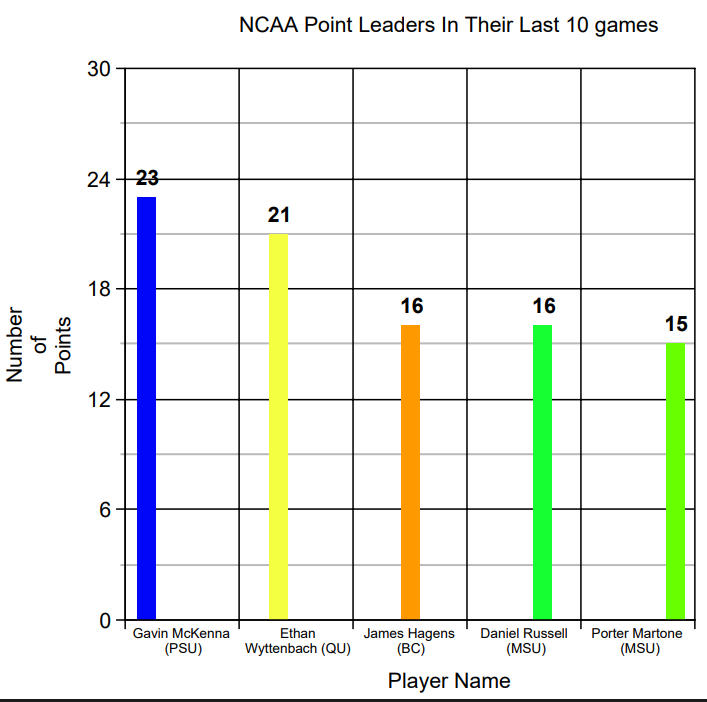
*Stats as of February 28th, 2026
Part 4: Reevaluate How We Evaluate
Gavin McKenna is joining a long list of players that we (almost) moved on from too fast… It’s time we change that.
Recently, there’s been a shift in the development curves of some of North America’s best young players. The real catalyst for this was Jack Hughes back in 2019, when he was selected #1 overall by the New Jersey Devils and made the jump straight to the NHL. His rookie season was underwhelming - we all know that - but what set Hughes’ situation apart from the rest was the level of hype that he was facing coming into the league. He wasn’t given a chance to breathe before being submerged in talks of being a bust and a wasted pick. And in all honesty, they were fair conversations. I mean, what else are you supposed to expect from a generational talent that is supposed to be the face of USA Hockey for the next 10 years when he comes into the NHL as an 18-year-old? But those expectations are, and remain, the problem.
Since Hughes’ rookie season in 2019-20, we’ve seen multiple instances of players in similar situations, just not to the same extent. Quinton Byfield and Alexis Lafreniere both entered the league with high expectations, and when faced with similar starts to their careers as Hughes, a mix of pressure from the fans and the front office ultimately got to them. Connor Bedard also faced the same thing, despite producing at a solid rate and delivering many special moments throughout his rookie season.
I’m not saying that we need to take away having expectations for these kids. Not at all. Pressure is a privilege, and they have earned it. What I am saying is that these players still have so much longer to go on their development curve, and although we talk so much about how good they are now, they still won’t be at their very best for at least another five-six seasons. It takes time for players to finish growing, get stronger, and develop the mental side of their game to the point where they can execute at the level that their skill suggests they can.
McKenna has been a perfect example of this idea this season, and no, I’m not saying that the NCAA is the same thing as the NHL, but with the recent rule changes granting CHL players NCAA eligibility, it’s become a much, much better league. This means that, although it shouldn’t be to the same extent, we’ll need to have more honest conversations about how good we think players are versus how good they actually are. What I mean by that is that a good or bad stretch of games should no longer be the defining factor in a player’s draft stock tanking or shooting up. Yes, it’s important to reevaluate players every once in a while to check for legitimate improvements, but those improvements don’t happen overnight, just like a player doesn’t lose all their skill and ability overnight.
The truth is, McKenna, has always been the same player. From his season-opening game winner in Arizona, to his struggles against LIU and Stonehill, to his 8-point game last week, even to his 1st period blunder vs Notre Dame last night, and eventual shootout winner. The only thing that changes is his mentality and how he can bounce back from those moments on his next shift, game, or even season. What really matters when evaluating players isn’t just how fast they can skate, how hard they can shoot, or how quickly they can turn. Although those things are very important, what we can learn from McKenna, and not just McKenna, but Hughes, Lafreniere, Byfield, and every other young player, both in the NHL, or soon to be, is that easily the most important thing to evaluate nowadays is a player’s mentality.
A player’s ability to be absolutely present in the most important moments of every game, regardless of what has taken place leading up to that point, and also their ability to process both the good and bad, except both, and get better, is a necessity. We can see this growth in McKenna’s game throughout the season, and maybe the best example of it was his Bronze medal game performance. Coming off a debilitating loss to a team that the Canadians had beaten earlier in the tournament, it would’ve been an easy trap game for McKenna. Instead, a goal and 3 assists later, he’s leaving St. Paul with something to build off of for the rest of his season.
McKenna’s development curve has taken us through a roller coaster ride this season, which has ultimately landed us at the best possible version of himself that we’ve seen playing hockey. However, it’s also forced us to reconsider what we value in scouting. We’ve known for a very long time that hockey requires a lot more than just physical skill, but it hasn’t been until now that we’ve realized we’ve needed prioritize more than that in scouting. McKenna’s development hasn’t just benefited him, but has also allowed us to realize the true importance of the mental side of the game.

Thanks for reading!
Read more Dr. Tee Scouting articles here.